Episode Transcript
Jeremy VanderKnyff (00:00)
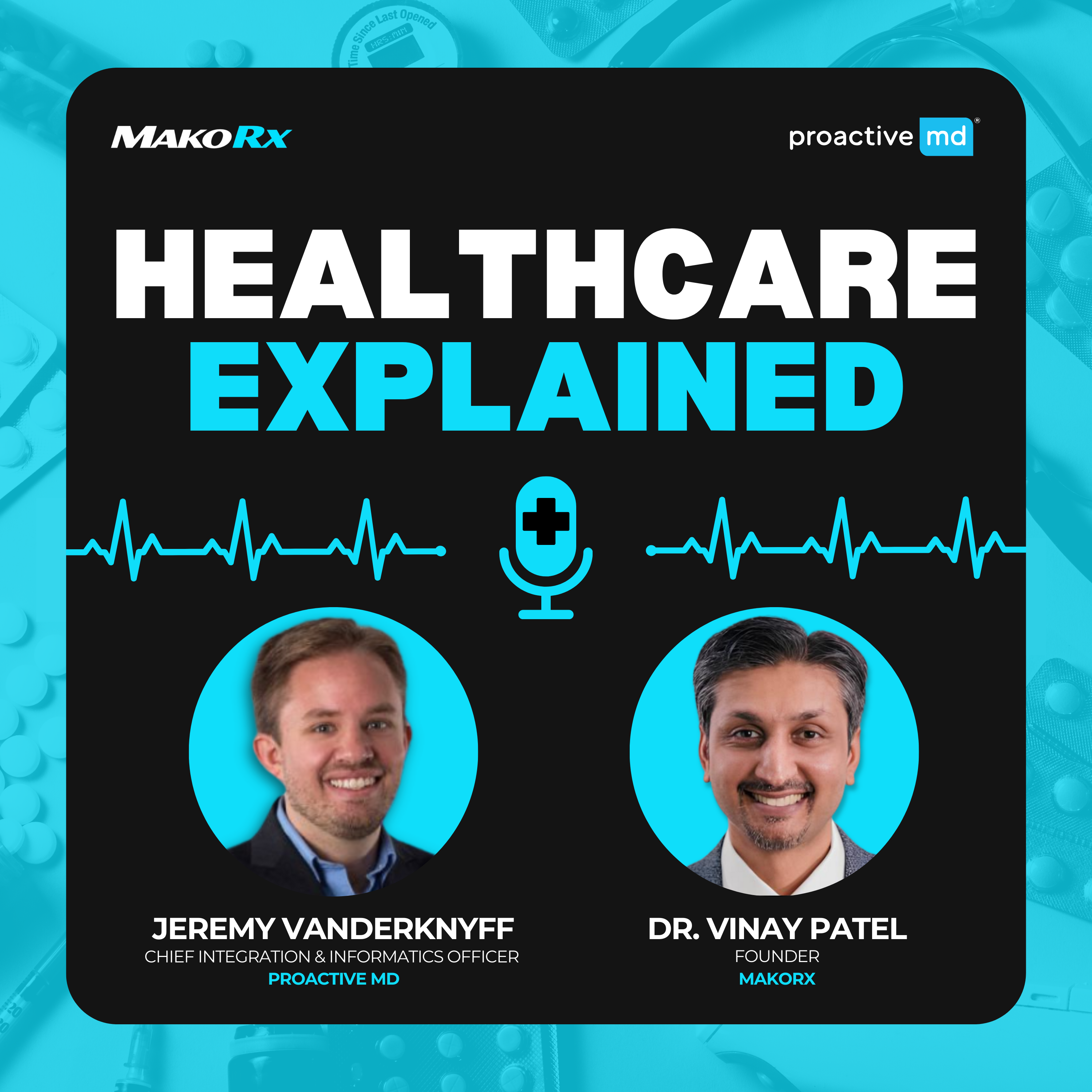
Proactive MD, this is Healthcare Explained. I'm Jeremy Vanderknyff.
Vinay (00:04)
And I'm Vinay Patel.
Jeremy VanderKnyff (00:06)
Alright, Vinay. ⁓ you know, we just wrapped up our series on elder care, which was probably a pretty certainly for me, a heavy topic. ⁓ but you know, we've gotten some really good outreach actually from listeners on ⁓ figuring out their own ⁓ end-of-life planning ⁓ and senior care planning. ⁓ but let's let's pivot this time ⁓ away from maybe such a heavy topic and let's talk about the the thing that everybody loves to talk about, which is how much healthcare costs. And specifically
Vinay (00:33)
Yeah.
Jeremy VanderKnyff (00:35)
you know, some strategies that employers can do to try to reduce that cost. So ⁓ what are your thoughts on this, Vinay?
Vinay (00:44)
I think that now more than ever, in the sort of state of economy uncertainty that we're in and the pressure that's be being put specifically on employers. I mean you think about ⁓ the the segment or the s section of the economy that's really having to take ⁓ a brunt of lot of the inflation ⁓ that's gone into effect is
One, consumers, but two, the companies that now have to deal with higher costs and what are we gonna do about that. And and in one area that we should always be paying attention to now again, more than ever, ⁓ is healthcare costs ⁓ specifically for ⁓ employers. And we're talking about on the, you know, smaller side, I think that we can all say for sure that the larger the employer, the more resources that they have, but on the smaller side, you have HR departments or benefits
groups that really are asking how can we address rising healthcare costs when year after year it goes up. And it used to be, you know, the standard, it's your two percent increase or it's your eight percent increase. Now we're seeing correct me if I'm wrong, Jeremy, you've had more conversations than I have with employers, but it's like fifteen percent increases and twenty percent increases are for some crazy reason being the norm now. And you know, the law of
you know, the the law of averages, you increase by two or four or six percent and you're gonna end up doubling your premium within seven years. and now if you have fifteen, twenty percent, you're gonna, you know, double it even faster than that. And keeping up with those costs are are really a big challenge. And so I thought it would be a great time or opportunity to discuss some tools that people may not know are laying on the table that they should look at and, you know, explore with their consultants and use ⁓ you know, use Proactive MD as a resource as well for
For the for our clients. What do you think, Jeremy?
Jeremy VanderKnyff (02:43)
That sounds great. ⁓ yeah, you know, you're absolutely right. We're seeing healthcare costs and a lot of clients that we talked to, ⁓ and employers of ⁓ you know, more than twenty percent. We talked to one recently that at a thirty-nine percent increase year over year. And, you know, there's a lot of factors, some of which we've talked about on this this call, everything from, you know, increased utilization of specialty drugs, GLP-1s, of course, are driving up pharmacy costs. ⁓ and then, you know, other economic
pressures, right? As as we see an end to ACA subsidies, you know, that changes the revenue that insurers have, which causes, you know, ⁓ you know, b challenges for some of their other plans that increase costs. At the same time you have, you know, different economic pressures on the health systems and the the healthcare providers themselves that are needing to increase. ⁓ and so, you know, there are all these different economic pressures that are resulting in that. ⁓
that very large increase that we're seeing these days. But ⁓ with that in mind, Vinay, ⁓ what's one of the first strategies that ⁓ small to mid sized businesses can look at for ⁓ if they're self funded for reducing their healthcare spend?
Vinay (03:57)
Yeah, so one of the first topics that we came up with was centers of excellence. ⁓ and centers of excellence, just for everyone's awareness, they route employees to high quality, high volume providers for specific high cost procedures, often with bundled pricing and outcome guarantees. So we're not just talking about ⁓ getting patients or getting employees or members to the lowest cost care. We often find that the higher the quality care some is is
again, ironically, the lowest cost ⁓ care for ⁓ for patients and and they oftentimes have better outcomes so that leads to lower downstream costs as well, not returning again, you know, readmissions to the hospital or or issues fixing things, infections that happen as well. I'm having to have new surgeries done, so on and so forth. ⁓ and s so here's what we've seen that's working now, ⁓ just from a high level.
So the vast majority of large employers now offer at least one center of excellence, with most with the most common access point being through their health plan carrier. ⁓ COEs are, you know, what the abbreviation now are emerging in areas beyond musculoskeletal and cardiac, including cancer, bariatric surgery, fertility, maternity, acute mental health, eating disorder, substance use disorder, ⁓ and even cell and gene therapy. ⁓ there's been reported savings from COE arrangements that you know could be significant.
For example, MRI pricing through direct contracted COEs can run around five hundred dollars versus fifty five hundred dollars for an in standard PPO network. so that's you know forty percent savings for select procedures. That's sort of the high level. What ⁓ what else can you share about you know centers of excellence?
Jeremy VanderKnyff (05:40)
Yeah, we've had clients and patients who have participated in these types of programs. and ⁓ you know, it a lot of it comes down just like any anything else, where there's a spectrum of quality ⁓ and and what you can expect. So one of the things that we recommend employers do if they're considering this is to work with their consultant and and ask the question of how the quality ratings, you know, or the selection criteria for
center of excellence ⁓ are determined. And the reason I say that is there are some ⁓ some groups where they ⁓ you know they really vet, identify the highest quality facilities for particular conditions, particular procedures, and build a network around quality. ⁓ there are also some carriers that build COE programs that are more based on they're able to get a a a lower cost ⁓ and it's more of a financial arrangement. ⁓ you know, and so it's it's always worth
There's no s you know, international or universal standard for what defines a center of excellence. so it's always good to to research and understand how these these ⁓ programs were selected. and you know, one of the the things that I think you mentioned, for example, travel surgery programs. ⁓ that's an another opportunity that can be great. Those kind of come in two different flavors. One is ⁓ within the United States, there are groups like Edison Healthcare that have
you know, created these networks of what they call smart care centers. And these are very well known names, you know, like the Mayo Clinic, the Cleveland Clinic, ⁓ you know, that specialize in particular ⁓ you know, treatments such as ⁓ cancer or transplant ⁓ or orthopedics, ⁓ where, you know, in these cases, because they're able to get preferred rates, ⁓ it's typically handled outside of the insurance carrier. The self-funded employer works with Edison's TPA to be able to
you know, pay those claims, but there's substantial savings for the ⁓ you know, it's typically zero dollars out of pocket for the patient and substantial savings for the employer ⁓ or the health plan. but there's also medical tourism. there are groups out there that have international centers of excellence that they would say where ⁓ you know, it because internationally in in countries like, you know, ⁓ Thailand and Vietnam or Mexico.
⁓ you know, you can travel and and get a procedure like an orthopedic procedure, ⁓ you know, much cheaper than you would ⁓ at a US based healthcare facility. ⁓ again, that doesn't necessarily mean that ⁓ just because they're international that they're not high quality. But again, you know, it's it's buyer beware. So, you know, just ⁓ just talking with these vendors about how those centers are selected, asking for quality ratings, ⁓ you know, outcomes and treatment.
Vinay (08:10)
Yeah. Yep.
Jeremy VanderKnyff (08:33)
statistics that they have would be beneficial just to make sure that, you know, you are not sending your employee to a, you know, Joe's house of surgeries in a back alley somewhere, that it's a whether it's it's domestic or international, that it's a high quality sanitary facility with well trained, you know, physicians and surgeons and providers who are able to get them the care they need.
Vinay (08:42)
Yeah. Yeah.
Yep, agreed. Agreed. And you mention one thing or I wanted to ask you or bounce off you is once you have a center of excellence, just like with primary care and advanced primary care, it's not like you get, you know, immediate engagement. You actually have to not only market and educate the members around the the center of excellence that you have, but then you also and correct me, you know, if you've seen differently, navigation is key to making
un help patients understand, okay, my doctor just recommended that I get a knee replacement or a hip replacement or I need to go get this imaging done. Now they're just telling me go down the hall, you know, the famous ⁓ statement that costs health plans the most money ever in a health system, and I need to know what are the other options, right? And so having a trusted navigator or resource that helps them ⁓ get to these, you know, high quality, low cost centers is
is one thing, it's super helpful. ⁓ have you s heard seen similar? You know, what what are your thoughts on on making sure that membership
Jeremy VanderKnyff (09:59)
No, you're you're absolutely right. Because it can be, especially if you're a patient who's just gotten some very bad news, right? These aren't all just elective knee surgeries where, you know, you it doesn't need to be done today even if you're in pain. You know, some of these can be things like transplants or or cancer treatment where it's it can be very hard to navigate these on on your own. And, you know, being able to make the connections between the ⁓
the center of excellence and your primary care provider or specialist who's, you know, making the referral for the treatment. Sometimes you have ⁓ specialists who work within a health system who are trying to advocate against, you know, ⁓ patients utilizing some of these programs ⁓ you know, and traveling outside of the health system to be able to get it. So ⁓ you know, it's it's a tough burden for employers if if that falls on HR.
to be able to do. So there are some opportunities. Many of these centers of excellence programs, whether it's through the carrier or through a program like an Edison Health or a medical tourism, have patient advocates ⁓ or client advocates who can help work directly with the patient so that they don't need to be able to navigate. And that can be everything from just making sure the medical records get from point A to point B to even, you know, handling the travel arrangements for, you know, the patient and their caretaker.
Vinay (11:08)
That's right.
Jeremy VanderKnyff (11:23)
to be able to, you know, or a companion to make sure that ⁓ you know they have a place to stay ⁓ during before and and you know during the recovery period ⁓ and and you know ⁓ handle those things which can be very difficult for a patient who might otherwise say, you know what, let me just go to the hospital that's down the street because, you know, I I I know how to handle that.
Vinay (11:43)
That's that's right. That's right. ⁓ and and sometimes costs are you know can be waived as well in those situations. ⁓ not always, but that could be an incentive for the member and also g help make sure that they know that someone that they have at least had communication or relationship with is helping them to go through every step of the process if they need to go internationally or or another step.
Jeremy VanderKnyff (12:03)
Exactly. And and when we're talking about savings of anywhere from, you know, as low as fifteen to as high as as fifty percent or more of the total cost of the procedure or that bundled episode of care treatment, ⁓ there's there's a lot of money that goes into that. If you're you know, you can certainly fly out, probably in first class a a patient, their companion and put up in a five star hotel if you're saving fifty percent on the cost of an open heart surgery, that can run
300,000, 500,000, a million dollars. ⁓ so they frequently will use that. We waive, you know, the member pays nothing, the patient pays nothing, including for travel and per diem, you know, the the COE program will handle all of that simply because the savings are so great and it it works in employer's best interest to take advantage of that to know they're being navigated to a high quality facility at a, you know, a a a much better price.
Vinay (13:00)
Yeah, agreed. Agreed. And you mentioned something that's key, which I would love to put a plug in for Proactive MD. You mentioned quality. in fact, Proactive MD is gonna have a quality tool that's coming out here soon, just ⁓ sneak peek for our listeners that keep in my ⁓ be aware that you know we're gonna have our own quality tool for the for all our clients that use Health Center so that we can help.
Jeremy VanderKnyff (13:23)
V Vinay, you know how I feel about plugging our product on the air. We're trying to educate, not sell. but that's absolutely true. ⁓ getting access to quality data is something that's very hard for many patients because it's hidden across sixteen different data sets and ⁓ you know, machine readable files and things like this from different health systems and whatnot. So ⁓ a little bit of a sneak pre preview, you're absolutely right. later this year we're we're announcing the launch of
care navigation tool that's gonna be available for providers and and patients to make it ⁓ easier to find those high quality facilities as well as be more transparent about the costs that that are behind that ⁓ you know on a procedure by procedure basis.
Vinay (14:06)
All right, great. Okay, so speaking of facilities, ⁓ we have sort of the biggest facilities around every employer are health systems. And I just read recently that there was a employer group in Indiana that specifically set up a direct contract with health s with a health system in their area. ⁓ essentially what
That meant to me was it was that the employer was either cutting out or reducing reliance on the carrier network and negotiating directly with health systems or physician groups. In this case, it was a health system. What we're seeing work now, ⁓ again, high level direct contracting adoption is accelerating fast. ⁓ in 2023 there was an 18% ⁓ or eighteen point seven percent of ⁓
groups contracted directly and then in twenty twenty five we have twenty seven point six percent of groups now contracting directly with health systems. And the purchaser purchaser business group on health launched a landmark employer coalition in Seattle, where Boeing 70,000 employees and others in the area, ⁓ which was another
large employer, including eBay, pooled contracting power with multiple health systems. The model integrates primary care, behavioral health, and physical therapy. I think that, you know, what's key here is that an employer should have a high concentration of employees in in a specific area for them to get sort of the leverage of contracting directly with health systems. Doesn't work as much if you have a national or a a s you know a mid-sized employer that has employees all over the country or works remotely.
and so that's sort of key or important to notice. ⁓ what else have you seen or or heard about direct contracting with health systems?
Jeremy VanderKnyff (15:50)
Yeah. ⁓ it is becoming more popular. and it's not just with health systems, it can also be with independent providers within ⁓ the community. ⁓ and you know, the benefit for these providers, whether it is a health system or maybe a physical therapy practice or an imaging center, is ⁓ a guaranteed volume. ⁓ you know, and ⁓ so for them it's hey, I I know this employer will direct.
Vinay (15:59)
Okay. Okay.
Jeremy VanderKnyff (16:16)
all of their or a majority of their ⁓ members to me. ⁓ so I'm gonna have some kind of guaranteed volume. And the other piece is because it's typically done as a kind of a cash pay ⁓ that doesn't go through a claim through the insurance company, they get paid faster, right? There's not a we wait for the provider to, you know, file the claims, wait for the insurance company to adjudicate, you know, and and wait for the, you know, all that those moving parts and pieces to happen.
so for a lot of groups it's hey, it's kind of guaranteed faster revenue and potentially more of it, even if we're taking a a lower cost. And these can be very, particularly in areas like imaging, these can be ⁓ excellent solutions for employers where, you know, depending on the market, you know, we see ⁓ an MRI ⁓ you know, being anywhere from $3,000 to $5,000 ⁓ when done at an outpatient
you know, hospital radiology facility. ⁓ when it's done through a negotiated direct contract, whether it's a freestanding imaging center or one that's contracted with a ⁓ with a health systems imaging center, ⁓ we can see MRIs for $400 to $1,000. So it's a very substantial savings. and it really were you know doesn't cause any ⁓ heartaches or challenges for patients, right? ⁓ it's still going to be a facility that's in their community.
and and as long as you've got that care navigation piece figured out, ⁓ you know, it it can be very seamless for them. The one thing that we've seen from both patients and and clients, employer clients, that we'd caution is when you're working with a direct contracted network, make sure that there's very clear lines of communication with the practice that will be receiving those patients. ⁓ you know, because particularly with health systems that might have, you know, dozens of billing specialists.
⁓ if not more scattered across multiple facilities, things like that. You know, sometimes groups will ⁓ you know, especially the patient who doesn't know, ⁓ this is a separate program than what's offered through my insurance. ⁓ you know, you might find a bill for something you thought was going to be through your contract negotiated price. So when having these types of contracts, you know, work if either with your benefits consultant, broker,
with your primary care provider, if you have an on-site ⁓ employer sponsored health provider like Proactive MD, ⁓ or if you're working and just negotiating this directly, always make sure you have a point person at the health system ⁓ or the practice, that anytime these things come up, because they will, right? ⁓ that you're able to get it resolved quickly. ⁓ and the other thing is make sure you're working this w tends to work better if you have a ⁓ a
Vinay (18:52)
Yeah. Yeah.
Jeremy VanderKnyff (19:05)
a TPA, particularly a TPA that's flexible. ⁓ yeah, we have heard stories about ⁓ you know, different carriers even among their their ASO, their self funded groups, where ⁓ you know, they they might hit buried within the contract, there could be language that can penalize a an employer in the ⁓ in the way of higher premiums ⁓ for you know quote unquote network leakage where a direct contract would be. So
Work with whatever experts you can, whether it's internal counsel, whether it's with your broker, ⁓ or with a TPA if you have a friendly TPA, to just make sure as you embark on this path that your contracts will allow it. And if they don't, that's a point of negotiation to have ⁓ as you seek renewal to make sure that you're not gonna get an unexpected bill.
Vinay (19:53)
Yeah. ⁓ all great points when contracting with health systems. there's i for those that ⁓ for those that feel like they're too small to contract with the health system, there are coalitions that you can contact or reach out to. We mentioned PBGH or the purchaser business group on health. there's also other ⁓ groups on health coalitions ⁓ across the country, ⁓ and like MBGH and
N E B G H. and then there's also local chambers of commerce coalitions as well. So make sure you reach out to ⁓ either your state or regional groups on house to see if that there you could join their coalition if you feel like you're ⁓ too small to be able to contract directly with a health system. ⁓ and okay. Next up
Jeremy VanderKnyff (20:40)
Absolutely. All right, Vinay, talk let's talk about let's talk about pharmacy. You know, as as we've talked about many times on this program, rising pharmacy costs are really killing a lot of employers. ⁓ and it doesn't look like there's there's an end in sight. ⁓ so what are some strategies to try to curb pharmacy spend that employers of this size, you know, might be able to partake in?
Vinay (21:06)
Yeah, ⁓ this is not only a a timely topic, but one that's inc ⁓ has increasing burden on employer groups. you know, five or ten years ago when you talked to employers, when I talked to employers about pharmacy costs, they're like, it's twenty percent of my health plan spend. I'm a little concerned about it, but not enough to be worried where we need to make changes or start implementing solutions. And fast forward now to you know, twenty twenty three to twenty twenty six.
Employer groups are now saying that pharmacy costs are 40% ⁓ or ⁓ upwards, 40% or higher of their health plan costs. And of that, half of it is coming from specialty drugs. And of course, we have our ⁓ favorite topic, GLP one drugs, that ⁓ is just a buzz every single quarter about, you know, are you gonna cover it? Are you not covering it? What are you gonna do next year?
And of course the demand for GLP one drugs has, even though it's they're relatively speaking for specialty medications, ⁓ you know, lower cost in the specialty space, ⁓ the volume sort of immediately ⁓ makes up a good chunk of pharmacy spend now from GLP one drugs. And you know, those costs and coverage con co conversations will continue to go on. I think that what's important when we're just talking about GLP-1s is to come up with
A plan on which patients you want GLP1s to help in your health plan and coming up with criteria, clinical criteria with resources from your consultant, resources from near site-on-site clinics like primary Proactive MD and other third-party vendors in this space that help you craft a high-value solution around GLP 1 so that we benefit the most people at the employer group.
We have our own strategies that we're talking to with our own clients around how to think about GLP1s. And now with a Lily and I believe Novo offering direct-to-employer type plans, you can you know exclude them from your health plan and figure out how to access them directly with Lily. If it even includes shared savings options as well. So those are some ⁓ just ideas and concepts around just specifically GLP1 medications. The
Other big chunks of bucket in in in pharmacy is generic medications and traditionally brand name medications. Those are really based on contracts that you have either with your PBM directly or with a carrier if you're with a carrier plan that has an integrated PBM. Please, please look through your contract that you have with either your carrier or your PBM. That contract language is so important that dictates exactly how much you're charged for medications, how brand how medications are defined.
There's standard definitions for medications, but there's, you know, very flowery language that makes you think that it's easy to define these drugs, but that definition is so important. ⁓ and then, you know, rebates that are in there and so on and so forth. And there's plenty of third party vendors that can help you look through your contract and and help you renegotiate it or help find areas where you can help you know optimize your your contract. So please look through and make sure that your
As an employer in general, you're moving away from legacy contracts. Those are typically what's called spread pricing contracts, where you get charged more as an employer than what the pharmacy got paid and the middleman keeps the difference, ⁓ to more pass-through transparent. ⁓ you know, those contracts are typically offered by smaller PBMs, independent PBMs, that, you know, are really looking to, and here's the key word, lowest net cost. If you're just
Chasing rebates, which I know it's easy to and it and it's ve it makes it seem like you're saving a lot on your health plan when you get a big rebate check. Think about it this way the higher the rebate check, it means that you've spent more on drugs to generate those rebate savings. Essentially, the smaller the rebate check, but the lower your ultimate pharmacy cost ⁓ for the year ⁓ could be more beneficial to you. But that's all just a conversation, you know, to have with your benefits consultant ⁓ and looking at these, you know, smaller pac con
pass through transparent PBMs can help ⁓ in that area as well. And then finally, an area that is becoming more and more interesting or popular is essentially carving out specialty altogether from their health plan and managing it directly, managing it either directly with a specialty pharmacy partner or realizing that, you know, you can ⁓ you can contract with specialty medications, you know, for those that
ma may not be covered through ⁓ the health plan through a special arrangement with stop loss carriers and that again go direct or have direct options. So those are just a couple of ideas around pharmacy. And of course there's drug savings programs that we've built internally for the PMD clients that, you know, are helping them to generate savings around specialty medications and brand drugs as well. And so there's just a plethora of options out there now more than ever around pharmacy with
It being disrupted so quickly given how fast the costs are rising.
Jeremy VanderKnyff (26:26)
What's the easiest way for employers to be able to get involved in some of these ⁓ programs that you've mentioned, whether it's trying to take a look at a ⁓ you know, a contract renegotiation or ⁓ changing PBMs or ⁓ you know, participating in these carve out programs and negotiating with specialty pharmacies?
Vinay (26:47)
So, you know, my recommendation would be lean on the best resource that you have as an employer, which is your benefits consultant, and ask really good questions and ask open ended questions about what do you know about, you know, other programs that are available around these areas. You have a great consultant, they're gonna do their job, do their research and come back to you with some options. ⁓ outside of that you can do your own research and go directly to ⁓ you know, what's known as the
open web, which hopefully stays open for much longer, ⁓ where you can then do, you know, research and find vendors that offer these solutions. ⁓ you know, we've we've heard of of some. We haven't directly interacted with them and so I don't have recommendations around that, but there are plenty of vendors out there and as long as you vet them thoroughly they can and that they're gonna do a specific task for you. Don't have, you know, like
Consulting firms come in and just look at you know, look at our business, tell us where we can be better. That's gonna be a much broader request that's gonna get you ⁓ hope maybe not what you're expecting, but if you go in with I'm looking for a vendor that can help look at my PBM contract and find where it's gonna be optimized, that'll give you a specific vendor that, you know, are much ne more niche and much more specialized and there's only a f handful of folks that do that. and so be be very specific when you're looking for these vendors and you know, and definitely start with
Your benefits consultant and see what they can come up with you for you.
Jeremy VanderKnyff (28:08)
and I'll throw in a plug for the Granite List friend of the show, the Granite Lists, ⁓ which cure has curated ⁓ you know, ⁓ different healthcare s point solutions ⁓ that employers are able to go and browse that marketplace, I believe for free. ⁓ you know, to be able to be connected with ⁓ with vendors that, you know, within that niche that they're looking for. So that's another resource that employers could potentially use, to be able to connect in with some of those
Vinay (28:11)
yeah. Yeah, yeah, that's right. That's right.
Mm-hmm.
yeah.
That's
Jeremy VanderKnyff (28:38)
some of those different solutions.
Vinay (28:41)
Alright. And now a topic that ⁓ we are very familiar with and and ⁓ experts in. What ⁓ what do we have to share with employers around advanced primary care or on-site clinics? ⁓
Jeremy VanderKnyff (28:56)
They don't work. Just forget I I can't. Obviously I'm biased working for Proactive MD, but you know, having access to an you know, a ⁓ advanced primary care. And if you look at definitions of advanced primary care, ⁓ you will find a thousand of them. ⁓ some of them will refer to it as an offshoot of direct primary care. ⁓ some of it will just refer to, you know, more person centric, you know, more white glove type care. All of these are are
are true in some way. I think the key thing with advanced primary care for employers is having access to something that moves more of the dollars out of the the crapshoot of of the insurance world where we don't know what we're going to pay until the bill comes, you know, from our TPA ⁓ and moves it into a more predictable cost that's more accessible for your employees and their families.
Vinay (29:42)
Hmm, yeah.
Jeremy VanderKnyff (29:54)
⁓ and whether it's done through a per member per month cost or a fixed fee or some form of pass-through that's negotiated, ⁓ something that essentially says, okay, this is the pot of dollars that we're allocating for primary care. And, you know, partnering with a high quality provider like Proactive MD, though we're not the only one out there, in fairness, ⁓ you know, to be able to bring that type of care. ⁓ you know, some groups, particularly smaller groups, may find
that there are direct primary care practices with employer health options that are within the community. You know, these might just be an independent one or two practice type ⁓ system that are looking for volume. They're looking for employer ⁓ lives to be able to and we'll give a you know sometimes a very substantial discount over a retail price ⁓ to be able to to take care of that population. Again, volume and having, you know, ⁓ you know expected revenue coming in that's predictable.
⁓ works in their in their favor, of course. ⁓ or partnering with a national vendor like Proactive MD to be able to ⁓ whether that's bring it in an on-site clinic where you know you've designated a space within your facility or on your campus that's exclusive to your members ⁓ or leveraging a a near site or shared site within the community where maybe multiple employers are coming together to be able to support the cost of that. ⁓ you know this is
⁓ again, I I always have to to state that I'm biased, but one of the most critical things, because as we're talking about all these different options, whether it's centers of excellence or pharmacy programs, ⁓ having a you know, that only works if the patient is being navigated the right way. And when you've got a partner that understands how your benefits work, and so their primary care says, hey,
Vinay (31:35)
Direct content.
Jeremy VanderKnyff (31:48)
You have access to this center of excellence program. So I'm not just, you know, gonna hit the easy button and refer you to the hospital that's next door or that owns my practice. I'm gonna get you to the right provider at the right cost and and hold your hand throughout it. So from a care navigation, patient advocacy perspective, having APC ⁓ as part of your toolkit is absolutely key, as well as just pulling, you know, we call them reverse referrals, pulling more visits out from
⁓ community specialists for uncomplicated, you know, as as we've said a a million times, you don't need to go see a cardiologist to get your blood pressure checked when you're on lysinopril. Cardiologists absolutely have their place, right? Endocrinologists absolutely have their place, but you know, that place is not to just, you know, do a $300 A1C on you that could be done for six dollars within an on-site clinic. So ⁓ you know, being able to have that as your first line of defense
Vinay (32:17)
Win more.
Jeremy VanderKnyff (32:46)
And then bringing those different benefits together and navigating patients to them, as well as being able to monitor how your healthcare spend is going and having a partner that can work alongside your benefits consultant to bring those strategies forward and think about, hey, how can we deploy them at an i within the exam room, right? ⁓ when we have the patient there to make sure that, you know, this will be most effective, having it come from their doctor is a really great way of ⁓ of doing that, which
doesn't really work in practice in a lot of fee for service medicine because there might be three hundred primary care physicians, ⁓ and nurse practitioners and PAs that your your employers are going to. ⁓ and most of them are not gonna have the time to be able to be educated on that you know, individual employees' benefits. So having a partner who who serves as that hub ⁓ can be a v a very good way of
reducing those healthcare costs. And we'll link to a couple of surveys, ⁓ not surveys, excuse me, we'll link to a couple of studies in the show notes ⁓ alongside this show that have shown and demonstrated the value of advanced primary care ⁓ at reducing employers healthcare costs.
Vinay (33:47)
Okay.
Awesome. I think you you highlighted a couple of great points when working or or ⁓ evaluating ⁓ advanced primary care. And that's you know, one concept is you're you're as an employer, you're guaranteeing volume or revenue to a specific primary care group when you when you're taking on this kind of arrangement and with that leverage
you should be asking about what kind of care coordination gets done, what kind of specialty referrals are we going to be able to minimize because we have this relationship you'll have this time and relationship with our patients. And then finally, holding them accountable to outcomes and clinical, you know, clinical benchmarks that ⁓ can and should be met when, you know, they have all this time and they have this fixed revenue. So it's, you it's definitely a two way street and have to make sure you you take into account to hold ⁓
partner accountable for the leverage you're bringing them. Alright. Well with that, I say that, you know, we can wrap up this episode with our famous what do you want to leave everyone with?
Jeremy VanderKnyff (34:55)
Absolutely.
⁓ it's a great question. As always, Vinay it's a great question. ⁓ you know, for employers, ⁓ I'd love to say healthcare costs are going to go down. They're not. ⁓ not in the foreseeable future because it would require such massive overhaul and policy change. but that doesn't mean that you're helpless. ⁓ you know, definitely if you have the luxury of being able to be self-funded, ⁓ that helps you be able to bring in more of these solutions.
don't fall into the trap as we've we've talked to a number of different employers who think that, you know, they're hedging their bets and they're reducing their risk ⁓ by, you know, remaining or going fully insured. ⁓ because not only does it reduce your flexibility, ⁓ and the nimbleness with which you can bring in other solutions, but when you talk to fully insured employers who are suddenly getting a thirty percent increase, you know, on their ⁓ you know, annual renewal, ⁓
you know, it it it makes you question whether having been self funded, would you still be seeing that type of increase? So don't lose hope. ⁓ and ⁓ you know self-funding there's different self-funded level funded plans for employers of all shapes and sizes. and ⁓ you know ⁓ still be able to give you access to the the value that large carriers can bring as well, depending on how those relationships work. How about you, Vinay? Anything you'd leave our listeners with?
Vinay (36:32)
Yes, that's right.
I I would tag on to exactly what you ended with, which is for our employers, self funding gives you control. Today, evaluate how much control you have with if you have a carrier relationship that's not self funded, ⁓ and realize that's what it allows you. Not only that, but it also allows you some visibility and transparency into where your claims are going, how much the claims are costing you.
wh and when what you're paying for those claims. And with that information, transparency and the control, now you get to dictate, okay, well for this high cost group or h this group of patients that are that that are having high claims, here's what we're gonna do for those. And that's really where you get to be back into the driver's seat and not just, you know, yell and scream every year when the costs go up. ⁓ so so yeah, that's that's my golden nugget for
For this episode.
Jeremy VanderKnyff (37:35)
Alright, well once again from Proactive MD, I'm Jeremy Vanderknyff. This was Healthcare Explained, and we'll see you next time.
Vinay (37:38)
And I'm Vinay Patel.