Episode Transcript
[00:00:00] Speaker A: Proactivemd.
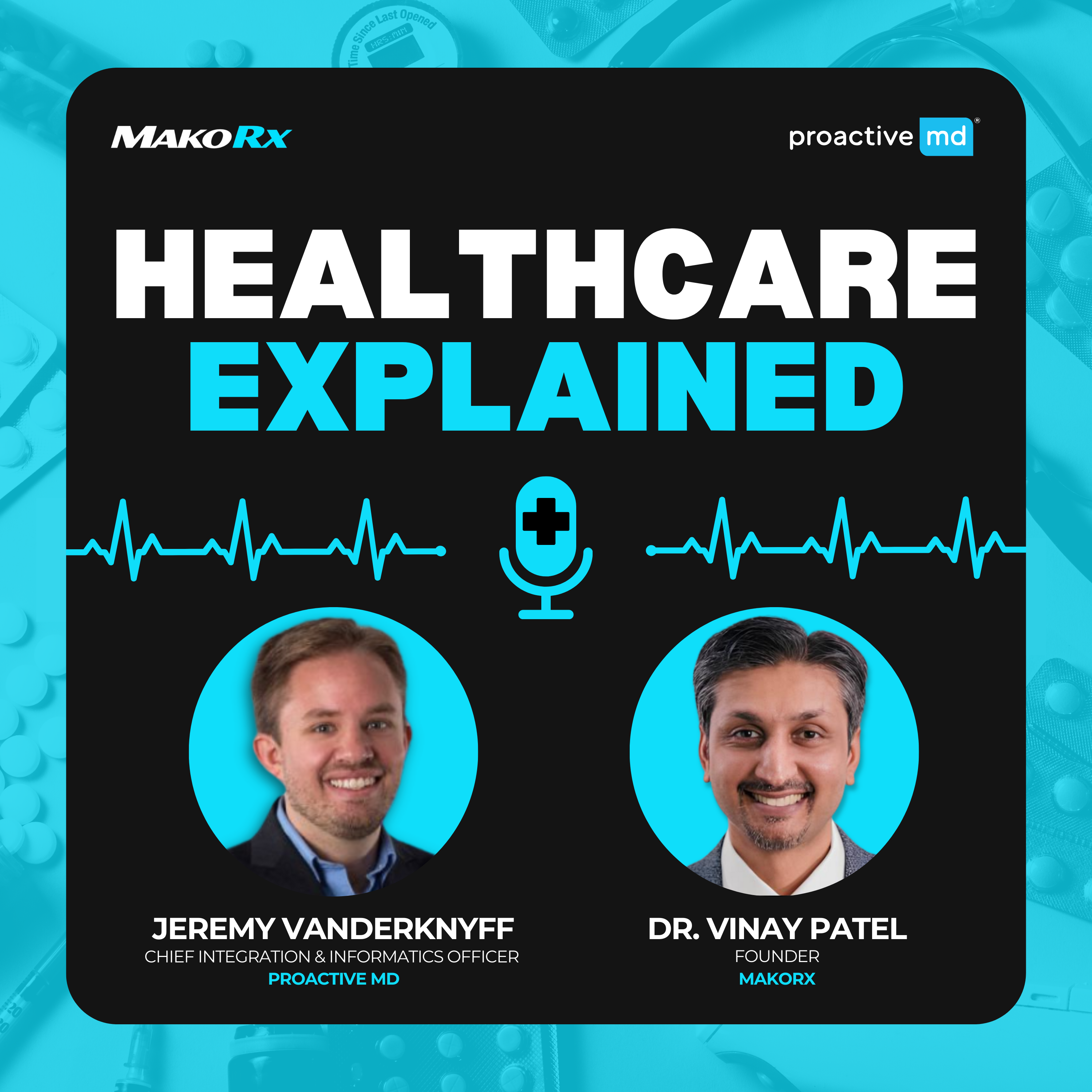
[00:00:09] Speaker B: From ProactiveMD, this is healthcare Explained. I'm Jeremy Vanderknife.
[00:00:14] Speaker A: And I'm Vinay Patel.
[00:00:16] Speaker B: Vinay, it has been a while since we've done one of these. I'm happy that this is the first episode of, I guess, a new season of Healthcare Explained.
With that in mind, what do we have in store for the show today?
[00:00:30] Speaker A: Today we're going to make it quick and give everyone their valuable information on Trump Rx. What is it, how it might work. We don't have a lot of details, but we'll share what we know and see if we can start an engaging conversation on this new tool to help save on medication costs.
[00:00:48] Speaker B: Excellent. Let it never be said that we don't court controversy, although we do try to be an apolitical podcast. But first, Vinay, if you remember our very first episode of Healthcare Explained, a year ago, we were reporting on the lab monkeys that had escaped from the facility in South Carolina.
[00:01:08] Speaker A: Yes.
[00:01:09] Speaker B: And I'd like to say it's just coincidence, but it happened again. It happened again in Mississippi. Truck full of lab monkeys.
[00:01:18] Speaker A: My goodness.
[00:01:19] Speaker B: Rhesus macaque monkeys. Florida flipped over and monkeys escaped. It was on its way either to or from Tulane University.
Whole lot of drama going on right now with officials trying to decide, you know, the truck driver had said they had been exposed to infectious agents. Then the university said, no, that's not true.
The sheriff's department isn't saying much. They have recovered some of the monkeys. One lady, the monkey approached her house and she shot it. But I think there's still a few loose, so. So I'd like to thank every season of Healthcare Explained we will be bringing you the latest and greatest in escape lab monkeys.
So with that in mind, Vinay Trump rx. Tell us about it.
[00:02:02] Speaker A: Yes, this was just announced last month, so we'll put some context around this over the summer. In August, the Trump administration signs an executive order requesting or demanding, I don't know, mandating that pharmaceutical companies provide the same pricing that they provide to other international countries and what's known as most favored nations. So we want the same best price that other tier one countries are paying for these medications that we pay for here.
And along with that, there was in August a press release out of the White House where they announced that that drug companies have until the end of September.
Otherwise they will be faced with tariffs on branded medications unless they're building factories here in the US or help to lower drug prices otherwise in the US and that deadline came close and it was, there wasn't much activity going on until sort of the last couple days and going into October when two drug companies had announced that they were going to be providing access to medications through Trump Rx. And that's what sort of sets the stage for this brand new website. It is a US Federal government website that will help to provide, think about it as not selling medications directly to the public, but giving you information about what would be the best price, non insurance, best price for that medication that you could get these medications for.
Got it.
[00:03:45] Speaker B: Well, let's let me ask you a little bit for our listeners, many of whom are either experienced within healthcare or have experienced healthcare themselves. When we talk about the cost difference between international drug prices and what we pay in the US either insured or uninsured, what are we talking about? I mean, what is the orders of magnitude difference?
[00:04:06] Speaker A: If you have some examples, we're talking about like for example, a popular medication, glp. One medicine that's available, Ozempic for example, it's available in England and Denmark for fifty to a hundred dollars.
Just again, that's just if you were to, that's just how much the medication costs to buy at the pharmacy and here we're paying $800 for the same medication. Again, that's just if you walked up to a pharmacy and said I want to buy this medication, how much would it cost? They would tell you standard retail price, somewhere between 800 to $1,000 for a month supply of that medication, where again, it's 10x less in other tier 1 countries for that particular medicine. Obviously every medication is different, but countries negotiate as a whole outside of the US and so they get traditionally better pricing than we do in the US where the negotiating is more. Drug negotiation is more fractured among private companies.
Got it.
[00:05:10] Speaker B: Kind of that difference in the way health care systems are working. A nationalized government where you have the buying power of an entire country's population compared to an insurance plan with a few hundred or even a hundred thousand people on it.
[00:05:23] Speaker A: Yeah, exactly.
[00:05:29] Speaker B: Mentioned tariffs as far as, you know, sort of the, the stick, if you will, versus the carrot of getting drug companies to participate. If the companies already manufactured their medications in the U.S. is there any consequence for not participating, you know, in the Trump Rx program? Are there any other teeth to the mandate or carrots if it were to help encourage more companies to lower drug prices even domestically?
[00:05:55] Speaker A: You know, honestly I haven't been able to piece together the details, the policy details around what kind of incentives and what kind of barriers there were to offering medications here. To the best of my research and information that I've gathered, I didn't see any additional incentives for drug companies to match or offer pricing here. You know, a lower pricing here in the US but, but there were, there were some incentives given to drug companies building plants here. I do, I do know there was some investment around drug companies building manufacturing plants here.
[00:06:30] Speaker B: Got it. So you're talking specifically about people paying the cash price and being able to provide some cost transparency to help healthcare consumers and those purchasing medications navigate to get the best cash price possible. So what, if anything, is this program going to do for those who have insurance through their employer, through an ACA Marketplace plan or something?
[00:06:53] Speaker A: So here's where it gets tricky. If you have a traditional health insurance plan where you go to the pharmacy and you pay a fixed flat fee for your medicines, usually called a copay, you are likely not going to see pricing as low as that on TrumpRx.gov if you have a insurance plan through your employer that is, or an ACA plan that's high deductible, where you have to pay the full cost of drugs and medical procedures and doctor's visits until you meet a certain deductible that when you compare that price, you may see a difference. You may see some savings on the TrumpRx.gov website where you could purchase these medicines direct to consumer from the drug companies themselves.
So you're not, you may not go to a local pharmacy to get it or a pharmacy like CVS or Walgreens. You may have to just go directly through whichever partner the drug company selected for you to get the medication directly through them.
And in those scenarios, here's the trade off. So you could potentially be paying hundreds of dollars less for a specialty medication or a brand medication that's offered through TrumpRx.gov but it's not going to apply to your deductible because it's not going through your insurance. And so that's the trade off here. If you're, you know, typically, or usually if you're on one of these medications, you have certain chronic conditions where you're expecting to meet the deductible every year and offloading to save a couple hundred dollars this month for thousands in potential savings after you meet your deductible is something that each individual is going to have to weigh and figure out. But that's the trade off. There's going to be savings for those on high deductible plans, but it may not apply to their insurance accumulators. Or insurance costs.
[00:08:42] Speaker B: Gotcha. And how does this differ from a program like Goodrx which we've discussed a couple times on the podcast before, you know they've, they've been involved in some antitrust, I think lawsuits in the past. But you know, that's something that a lot of pharmacies have posters right there at the, at the pickup window as far as you know, ask about our Goodrx price and things like that and you can cost compare different pharmacies through that website. Is this the same or is this a different approach?
[00:09:09] Speaker A: Similar, similar. The, the, the inner workings of GoodRx is different than what TrumpRx, at least what we understand of it. We TrumpRx.gov is going to go live in January 2026. There's a, a landing page or a splash page where it sort of gives you a high level overview that the federal government wants to lower price drug prices for consumers and, and people in the country. So, so the big difference is in Goodrx typically they negotiate or they work with pharmacy insurance companies to get you a lower cash price for generics and certain very specific brand medications that may have a coupon attached to it that you can get a one time discount and then pay the full price for these medications. So they're indirectly negotiating with pharma and sort of getting access at discount coupons for patients to go and get drugs that reduce prices at the pharmacies. Trump Rx again, inner workings is they've negotiated or they're working directly with the drug companies and they're offering specific medications at special pricing that they've negotiated or discussed or that the drug companies want to offer. For example, Novartis is going to be offering Cosentix at a special reduced price for patients. And then you know, Pfizer has said that they're going to be having some drugs on trumprx.gov same thing with AstraZeneca. And then interestingly there's also a fertility drug company that's going to be offering a medication through trumprx.gov as well.
Gotcha.
[00:10:44] Speaker B: Last question Vinay. When if you'll recall during the Biden administration there was a list of the drugs on Medicare that that administration had kind of targeted and made demands of pharmaceutical companies to lower costs, which they did and complied. But one of the criticisms that's been levied against that is while you're reducing the costs for, you know, Medicare Medicaid recipients for those drugs, when CMS is purchasing them, the pharmaceutical companies could and in some cases did turn around and increase the cost for those not on those government programs. Right. So commercial insurance, for example, do you anticipate, I know this is a crystal ball question, but, you know, I guess is there the possibility, or do you anticipate that the savings that, you know, consumers who are buying directly from these pharmaceutical companies, that there is a chance that those would be then passed on to commercial insurance parents through PBMs, et cetera, and potentially see costs rise, or is that off the table as far as your knowledge of this policy?
[00:11:48] Speaker A: That's a tough one. There's a very little information available to understand what's going to happen in the insurance market relative to what, what they're introducing as sort of this new twist in drug pricing for these specific small group of drugs.
If I had to postulate, just, you know, throwing out my random opinion here, I think that the prices that companies or employers will see for their insurance on these, for these medications, they're going to compare to what they're paying for these same medications through the insurance plan. They're going to go back to their pharmacy insurance companies or health insurers and say, why can't we have that price? Right? I mean, there could be some companies that are getting a lower price than what the direct to consumer price is because there's rebates involved here. And that's going to be the extra calculation or factor of saying, okay, what I paid for the drug at the pharmacy minus what I'm getting in rebates from my pharmacy insurance or health insurance company. Is that lower than what this price I see that's available, that you can just go direct. There could also be collateral damage in terms of employers saying we could exclude some of these drugs and just ask members to go get this directly because it's significantly cheaper. And we could figure out a way maybe to get patients reimbursed for some of those medicines or something like that. It could get creative, but who knows? We have yet to see what comes after the New Year's. We still need to see the full website as well and all the details of how it's going to work. Where are people going to have to go to get these drugs in the mail? Are they going to have to now go through four different online pharmacies depending on the medication that they're taking? One through novo for the GLP1s, one through hims and hers for, you know, all their cosmetic drugs, and then they got the diabetes medicines here and the inhalers from here. And it could get just really chaotic for patients and really sad if it becomes something another thing that they have to manage and it becomes too unwieldy to figure out how to manage all of that and create problems. Poor outcomes at the end of the day, as a healthcare provider is what I worry about with people going all over the place to save money, you know, they should rightfully so, but manage all of it carefully.
Absolutely.
[00:14:01] Speaker B: Great points, Vinay. Appreciate the explanation. We'll all stay tuned and maybe do a follow up after the new year as the program is implemented and see what's changed, how it's working. So listeners, if you followed us along compared to the episodes we've, we've published previously, we're trying a new format focusing on the explaining part because quite honestly, healthcare news is changing every day and we're in the middle right now of, I think as of the day of recording, this is tied for the longest government shutdown in U.S. history. Over the summer, we saw a number of pieces of legislation be passed, including the one big beautiful bill act that has a lot of impact and implications on healthcare. And of course the government shutdown. You know, the key point that the Democratic Party is, is leveraging right now is the end of Affordable Care act subsidies, which of course has large implications for healthcare consumers and healthcare writ large. So we're gonna be trying this new format of just taking one topic because we can't keep up with the news, but maybe we can keep up with something that's, that's important, that's gonna have impacts for our, our listeners, be they healthcare consumers, brokers, consultants, employers, trying to figure this whole mess out. So, so with that in mind, Vinay, any parting words of wisdom?
[00:15:19] Speaker A: Don't look down as employers stay on point, get resources, have people reach out now before the end of the year as you have time with renewals coming up and, and the focus on healthcare cannot be let go. You can't, you know, now more than ever you can't have a passive attitude towards healthcare costs. It's just, it's, there's gonna be a big spike coming next year and we all have to just pitch in and figure out what we're going to do to help contain or manage those costs and keep people healthy.
Love that.
[00:15:49] Speaker B: All right, well, from Proactive md, this has been Healthcare Explained. I'm Jeremy Vanderknife.
[00:15:53] Speaker A: And I'm Vinay Patel.
[00:15:55] Speaker B: And we'll see you next time.
[00:16:04] Speaker A: Proactive md.